The FTX estate is paying. The biggest customer group — Classes 5A and 5B, where most ordinary account holders sit — has now been paid 105%. That is more than the full value your coins were worth on 11 November 2022, the day FTX filed for bankruptcy; the extra comes from the interest the plan pays. More than ten billion dollars has already moved.
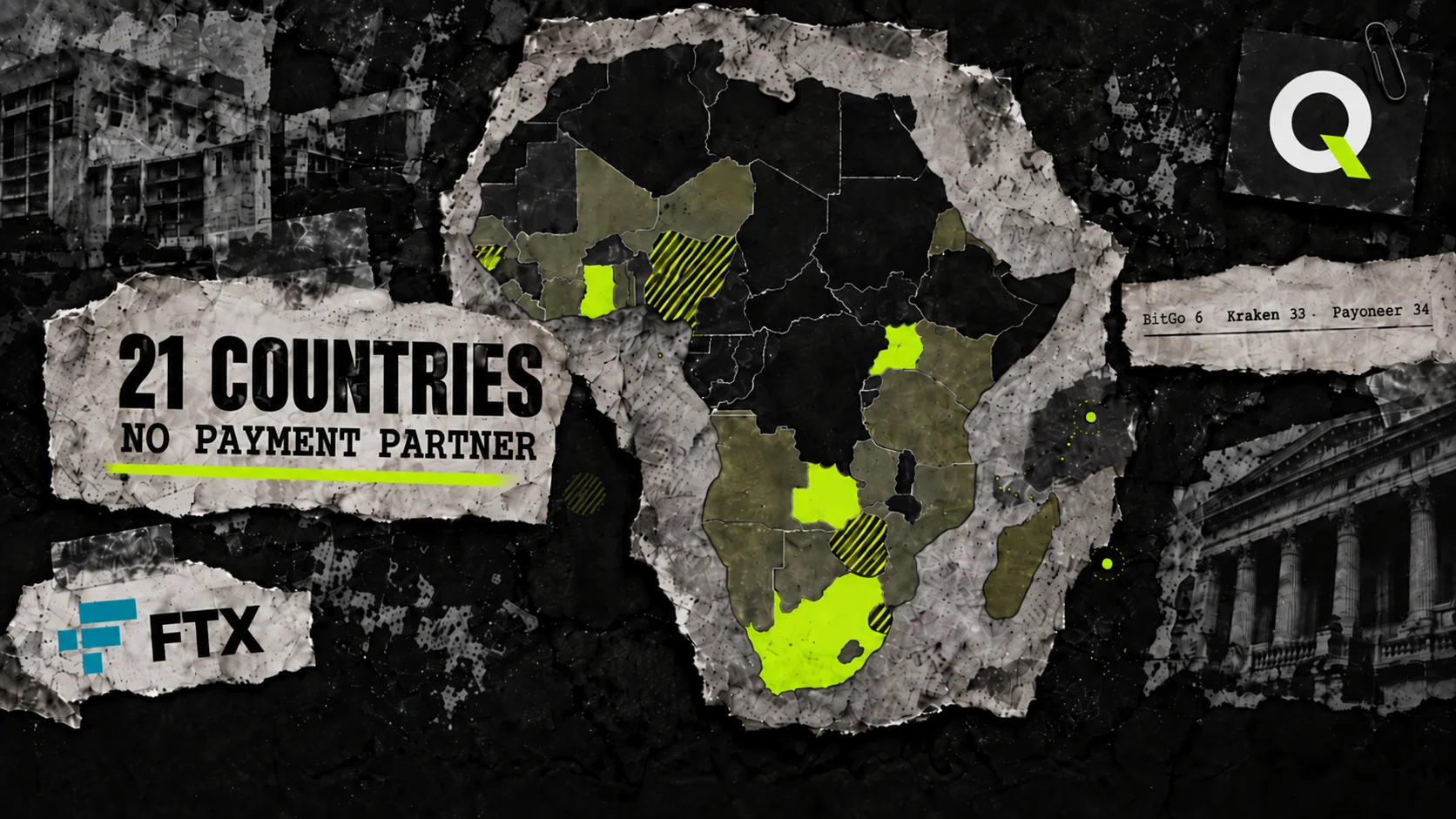
In twenty-one African countries none of it can arrive.
Add the five countries that depend on a single company, and it comes to twenty-six out of fifty-seven — nearly half of Africa's countries. In those countries a creditor either cannot collect at all, or can collect only through one company.
This guide explains where the money stops, which countries are in which group, and what a creditor can do about it.
The wall is one step in a form
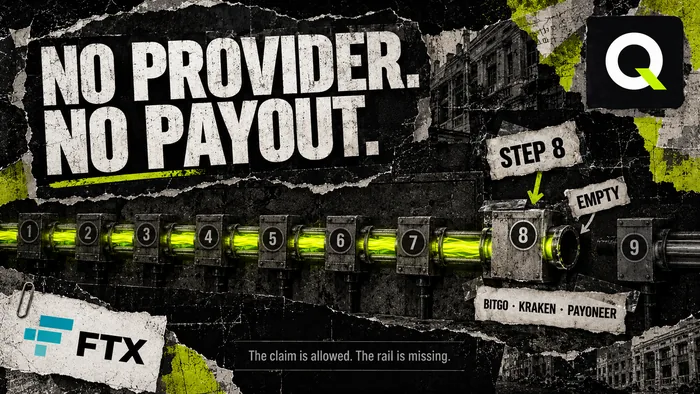
To get paid, a creditor works through a checklist in the FTX portal: prove who you are, file a tax form, then pick the company that will send you the money.
That last step is where it stops.
FTX pays through three partners: BitGo, Kraken and Payoneer. Each one publishes a list of countries it serves, dated 22 May 2026. You can only pick a partner that works in your country.
In twenty-one African countries none of the three does. The dropdown is empty. There is nothing to pick, so the process cannot go further.
Africa in four groups
| Group | Countries |
|---|---|
| No provider at all | 21 |
| One provider only | 5 |
| Two providers | 25 |
| All three providers | 6 |
Nobody serves these twenty-one: Ethiopia, Egypt, DR Congo, Sudan, Algeria, Morocco, Cameroon, Malawi, Chad, Somalia, Rwanda, Burundi, Tunisia, Libya, Congo-Brazzaville, Central African Republic, Gabon, Lesotho, Equatorial Guinea, Western Sahara and South Sudan.
They include three of the continent's largest countries: Ethiopia, Egypt and DR Congo.
All three partners work in six: South Africa, Uganda, Ghana, Zambia, Mauritius and the Seychelles. Six out of fifty-seven.
BitGo serves those six and nobody else in Africa. Not Nigeria, not Kenya, not Tanzania, not Egypt.
Nigeria is the weak point
Nigeria has the largest crypto audience in Africa and one of the largest in the world.
Its access to FTX payouts hangs on one company: Payoneer.
Nigeria is not on any blocked list. The portal works, the dropdown has an option, the money arrives. But there is no spare. If Payoneer stops serving Nigeria — the way partners have come and gone before — Nigeria moves into the first group overnight.
Payoneer was announced in June 2025 and first used for payouts that September. Before that there was only BitGo and Kraken, and Nigeria had nobody at all.
Four smaller countries are in the same position: Zimbabwe and Guinea-Bissau on Kraken alone, Eswatini and Saint Helena on Payoneer alone.
There is one more thing worth knowing. In July 2025 FTX asked the court for permission to hold back payouts to 49 countries. The request was withdrawn in November 2025 — but withdrawn "without prejudice", which means FTX kept the right to bring it back.
Why the line falls where it does
Nobody has explained it.
The three partners publish which countries they serve. None of them publishes why. FTX has not explained the gaps either, and the court documents give no reason.
Local crypto rules are the obvious guess. Egypt's central bank has warned against crypto, Tunisia restricts it. But that guess breaks quickly: Payoneer does not touch crypto at all — it pays into ordinary bank accounts — and it still skips most of the continent.
So the limits probably come from the banks that move the dollars for FTX, not from FTX itself. Nobody involved has said so publicly.
What this means if you hold a claim
Your claim is not cancelled. It is still valid, still counted, and still earning interest at the same rate as everyone else's. What is blocked is the delivery, not the right.
Waiting has no known length. FTX says more partners will be added. No date has been given, no name. The question has been open since mid-2025.
There is a deadline, and it is running. FTX has said that anyone who does not complete the last step — signing up with the company that will send the money — within six months of 31 July 2026 may lose the right to payouts on that claim. That step needs a partner. Twenty-one countries have no partner. FTX has not said what happens to people who cannot take a step that does not exist for them. The clock runs anyway.
Selling moves the problem to someone else. A claim sold to a buyer in a served country gets paid through that buyer's partner. This is why claims from blocked countries have a market at all — the buyer is not getting a broken claim, they are getting a working one that its owner cannot collect.
Selling from a blocked country
The paperwork is the same everywhere. A written agreement, then the transfer is filed in the court's claims register, which Kroll runs. After that the buyer is the recorded owner of the claim. Twenty-one days for objections, counted from the notice Kroll sends once it has checked the transfer, and if nobody objects, it is final.
Being in Ethiopia or Nigeria does not stop the transfer. It affects two things. The price — the buyer takes on the risk you are handing over. And how you get paid — usually in USDT, a dollar-pegged stablecoin, rather than through a bank.
For a clean, fully approved claim Qredax pays up to 95% of face value — that is the amount recorded against your FTX account. A claim still stuck in identity checks is priced case by case. The discount is what certainty costs — you swap an open-ended wait for a fixed amount now.
Whether that is worth it depends on how long you think the wait will be. Nobody knows the answer to that today.
Check your own country
Our FTX Payout Tracker shows which partners work where, with the date each list was published and a link to the document behind every figure. If your country has no partner, the tracker says so and shows the official statement it comes from.
The tracker is research, published as it stands. Qredax buys claims, which makes us an interested party. The data does not change depending on whether you sell.
No partner in your country? Send us the claim.
Your Kroll customer code, your claim class, and where you live. We reply within one business day with a real number. An NDA covers your documents before you share anything, and you are not obliged to accept.
Get a Quote